
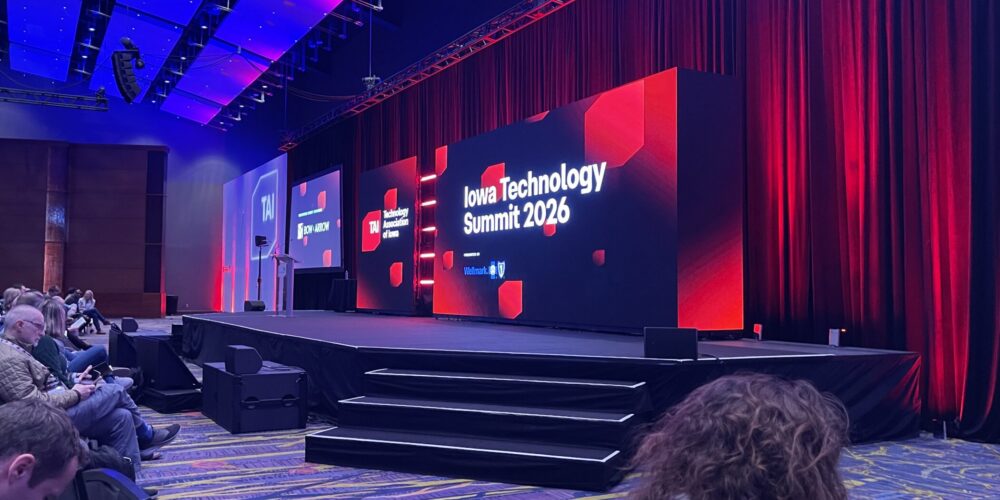
Last week Zirous attended Technology Association of Iowa’s 2026 Iowa Technology…
Summary
This blog explores how organizations can move from isolated agentic AI experiments to scalable, secure, and governed workflows. It highlights how Workato, paired with Zirous expertise, enables teams to operationalize AI and drive real business outcomes.
It starts off with a star employee building an AI agent with a ready-to-use agent workspace. The employee wants to automate something important to their workflow, like tapping into their sales account data to generate a tailored email and send it to a prospect. Soon, they share it in a team meeting and now everyone else on the sales team wants it. A different team hears about it, like Finance, and wants a similar experience for their contract data. Before you know it, different teams, different people, and even different people on the same team have their own bespoke AI agent without a clear way to scale, ensure governance, and protect client and internal data.
As powerful as some agentic tools can be for personal workflows, they can’t always keep up with team capacity. The challenge to the enterprise is how to build agents to scale in a way that operationalizes across your teams and the extended ecosystem. Enterprise workflows need a modern way to securely connect AI agents to their business systems to improve task efficiency, execution, and visibility.
Most agentic AI has a scaling problem
The promise of agentic AI is to take action on a user’s behalf by connecting into business systems, gaining the right context, and executing with the user’s approval. But, agentic AI can’t scale the same way as AI deployments in 2023 did. A couple years ago, business leaders could let workers loose on a chatbot to integrate into their workflows. Chatbots that generate text outputs rarely affect an overall shared business process, but instead profoundly change individual user workflows.
Fast forward to today, and agentic systems can retrieve business data, ask your tools to perform actions, and even modify your systems of record. Variation in the way an agent behaves is incredibly important, especially when multiple people depend on the outcome. Whereas business leaders could enable entire organizations on generative AI by simply giving everyone access to Copilot or ChatGPT, enablement on agentic AI doesn’t scale the same way. This is why agentic AI projects can stall out much more easily than generative AI projects do. Successful agentic implementation across teams requires standardization, governed access, visibility, and reusability. An enterprise alternative is to build an agent once as a shared workflow and action set, then reuse it across your teams.
The agentic governance gap
While plug-and-play agentic capabilities—like those you can build in Claude Cowork, or more technically with MCP (or Model Context Protocol) techniques—sound easy to spin up, they rarely meet governance and security requirements. As of writing this blog, Claude explicitly states that Cowork activity should not be used for regulated workloads. Capabilities like standard MCP techniques don’t have security built-in, and compliance fully depends on implementation. Especially in cases like identity management and protection, a user would have to explicitly program permissions for every single action the AI solution could take. Not only does this take an exceptionally long time to program, but the likelihood of getting it perfect is almost nil.
Not only do DIY agentic setups have limitations that can expose your data (and your users) to security risks, they also don’t provide visibility into what decisions are being made and how. Remember, agents take actions on behalf of human users. Without knowing how the AI agent performs actions, or for which users, the organization can’t reliably control who has access to what tools or prove accountability. Even if you could scale one-off agents easily (which our previous section proved otherwise), you’d never want to from a governance and security perspective. That’s why it’s so important to think about an enterprise strategy that encompasses identity, authentication, and security.
Layering action into agentic AI solutions
The industry has been hearing about agentic AI since 2024. In those early days, agentic solutions functioned like “information brokers,” meaning they could tap into a variety of places to surface information. For example, you might have asked an agent, “What’s wrong with the contract records?” and it might be able to surface discrepancies in MSA agreements and actual dollars received.
Today, workers want more than that. Now, organizations have the opportunity to not only tap into multiple places for information, but to actually take actions in those places. It’s the difference from asking about discrepancies in the contract records, to asking the agent to reconcile discrepancies in those records, route approvals, update systems of record, then notify stakeholders of the change. Delivering these truly agentic experiences—ones that interpret your intent, adapt to changing context, and take the right action to accomplish your goal—requires the ability to tie directly into the systems that run your business, and to do so with governance and scalability built in.
Introducing Workato orchestration for AI-enabled work
Real transformation and ROI from agentic AI comes from connected, end-to-end, governed workflows. Workato provides a fast, secure way to connect AI agents to real business contexts within multiple systems at once, directly in the LLM you already use. Trusted by 50 percent of Fortune 500 companies, Workato provides secure access to enterprise data and business contexts so AI agents can take actions within the guardrails of your business processes.
For example, the business may want to reduce manual administrative work in the sales and resource management process. They create agentic capabilities in Workato to track contracts between Salesforce, Docusign, and email. The process is as simple as:
-
The user navigates to the AI interface they already use, such as Claude or ChatGPT.
-
They ask in plain language what they want the system to do. For example, “Update Salesforce to close opportunities we received signed MSAs for in Docusign this week.”
-
The AI routes the request to Workato, which does the hard work of planning the task by looking at the organization’s approved workflows and actions.
-
Once Workato comes up with the plan, it presents it back to the user for approval.
-
The user confirms the task, or clarifies the ask.
-
Workato finishes the task.
While the experience feels simple and intuitive to the user, Workato and your LLM of choice are working hard to achieve the goal. In the background, Workato allows the LLM to look at a structured set of actions it’s allowed to take. It might first tap into Salesforce to look for open opportunities, then jumps into the contract workflow to draft an agreement, pops back into Salesforce to confirm fields and status, into DocuSign to prepare the signing request, and then finally packages everything into a simple review for the sales rep. All these actions are pre-approved by your business leaders and IT team, but Workato has determined which steps and the order in which to do them to accomplish the user’s request.
Move from disconnected AI pilots to enterprise transformation
Plug-and-play agent workspaces might be one way to pilot an agent, but they aren’t a long-term, enterprise-wide strategy for true business transformation. Workato provides a scalable, governed capability to gain enterprise-ready automation for AI agents.
As a certified Workato partner, Zirous helps midmarket and enterprise organizations get up and running with Workato. We’ve been empowering organizations for over 40 years, bridging the gap between innovative technology and real business solutions. We help companies turn scattered agent experiments into repeatable, governed business actions across the enterprise. And, we were selected as Workato’s Emerging Partner of the Year for 2026, recognizing us as a standout partner in delivering innovative and powerful AI-orchestrated solutions.
If you’re ready to learn more, ask us about seeing a demo of Workato in action using the example we detailed above.
Related Posts

Comments (0)