
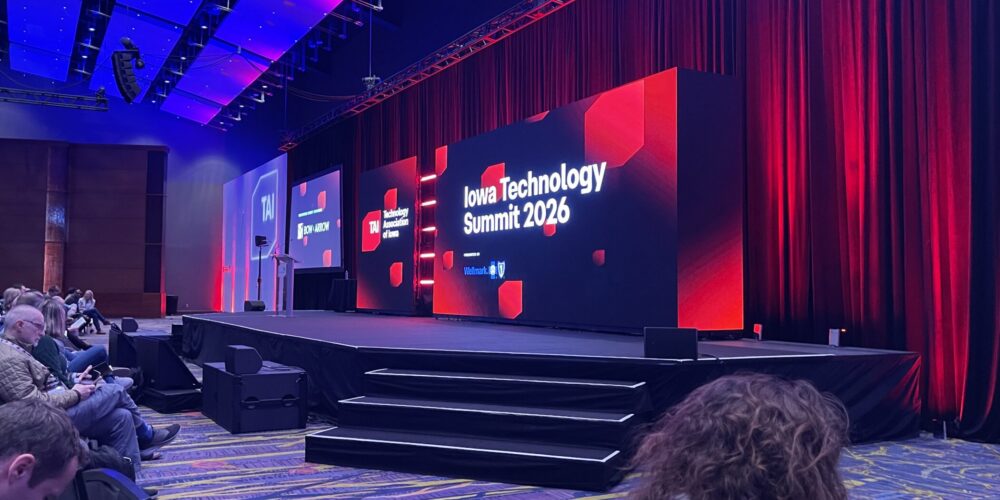
Last week Zirous attended Technology Association of Iowa’s 2026 Iowa Technology…
Summary
This blog highlights the next wave of AI innovation beyond agentic systems, focusing on multimodal AI, spatial intelligence, and quantum computing. It explores how these emerging capabilities will shape business applications and decision-making in the coming years. The piece encourages leaders to stay proactive by preparing their data, strategy, and investments for what’s next in AI.
2025 was heralded as the year of agentic AI. As AI capabilities evolved from chatbots into more sophisticated agents capable of reasoning, planning, and remembering, organizations began automating tasks and niche workflows. Agentic use cases weren’t just to create efficiencies and accelerate timelines. Workers leaned on automation to free up their time for more high-value work, alleviate task repetition, and identify areas for quality improvement.
While we’re still in the early days of agentic AI becoming embedded within organizations (McKinsey reports that one in four organizations are scaling an agentic AI system somewhere in their enterprises), it’s also worth preparing for the next waves of AI capabilities. By looking ahead, companies can start to consider applications and possible innovations early so they are ready to take advantage of the technology when it arrives. Although predicting the future of AI can feel a bit like looking into a crystal ball, we at Zirous think there are three frontiers worth paying attention to in 2026 and the coming years: multimodal AI, spatial intelligence, and the implications of quantum computing.

Multimodal AI Explodes in 2026
Multimodal capabilities have been improving over the last couple years, with expectations to surge in 2026. Like its name suggests, multimodal AI combines multiple different types of data (or “modalities”) as well as produces outputs beyond simple text. By leveraging data sources like images, video, and audio alongside text, multimodal AI identifies more contextual insights and improves complex data analysis. For example, the healthcare industry may leverage multimodal AI to analyze an MRI scan (visual) with a patient’s medical history (text) and recorded visit conversations (audio) to support diagnosis and treatment plans. Or, maintenance teams may analyze sensor data such as thermal images (visual) and acoustic clips of parts running (audio) alongside work order history (text) to improve predictive maintenance and lower product downtime.
Multimodal capabilities have the potential to:
- Manage more precise, tailored, customized workflows. By merging different types of data inputs—such as audio recordings, screenshots, and images—the technology can be more deeply grounded in your business contexts. As a result, teams and organizations can generate a wider variety of outputs that tap into more of your business contexts.
- Enhance and improve data analytics. Where traditional data analytics relies purely on structured and organized data, multimodal AI excels in understanding unlabeled and unstructured data. By combining all types of data in the organization, teams can vastly improve all kinds of experiences—from front-end interfaces to back-end efficiencies.
- Personalize interactions. As tech giants and startups alike move towards natural spoken dialogue as an avenue to engage with users, organizations also have the opportunity to build more personalized front-end interactions based on visual, audio, and text outputs.
2025 showed the beginning of the surge towards multimodal improvements in foundational models:
- Google’s Gemini 3 model can now link audio cues directly to visual data, where prior versions processed video as a collection of static screenshots with an audio track.
- OpenAI’s ChatGPT-5.2 improved in understanding visual charts, such as reasoning about high resolution screenshots of interfaces from 64.2% to 86.3% accuracy.
- Claude’s Opus 4.5 currently scores an 80.7% in visual reasoning in benchmark tests.
As capabilities improve, the market will see more improvements in the foundational AI tools and also newer solutions built specifically for multimodal use cases in mind, especially in areas like diagnostics, customer support, healthcare, and R&D. But, multimodal AI capabilities are only as good as the data it can access. If you’re the type of company that wants to fully access business intelligence in all your data in 2026, the time is now for a strategy on consolidating and governing your unstructured data. Zirous’s data division establishes reliable, consolidated data stores that set organizations up for data analytics and business insights.
Spatial Intelligence Builds Momentum in the Next Few Years
As multimodal matures, spatial intelligence—or the capability for AI systems to understand, interpret, and interact with a physical or virtual 3D world—is starting to build strong momentum. Spatial intelligence is foundational to enabling AI systems within both robotics and immersive virtual environments, allowing the AI system to reason and move within space, predict and analyze physics, and estimate distance and size. Businesses that rely on the physical world and virtual experiences stand to gain the most from spatial intelligence, such as in logistics, engineering, manufacturing, and field services in order to test changes virtually, guide work in-context, cut costs, and compress cycle time.
In order for spatial intelligence to power AI systems, it needs capabilities around (1) perceiving physical spaces or products and representing them, (2) understanding and verifying cause and effect, and (3) choosing actions, making recommendations, and updating recommendations based on results. In 2025, we saw two major advancements in operationalizing these capabilities: world models and enterprise platforms.
World Models
Most mainstream generative AI models can’t accommodate spatial intelligence, requiring a new kind of AI model that takes physics and simulation into account. In 2025, we started to see these kinds of AI models emerge. Called “world models,” these systems understand the physical and spatial dynamics of the real world. World models are useful for situations like training, scenario exploration, and predicting cause-and-effect.
Both Google DeepMind and Meta released world models in summer, and the heralded “godmother of AI” Dr. Fei-Fei Li at Stanford University launched Marble, described as a first-in-class world model that creates 3D worlds from image or text prompts. Although today Marble only enables users to create outputs that simulate realistic physical environments, the lab aims to push towards interactivity to unlock use cases in simulation and robotics.
Enterprise Platforms
For businesses that are building enterprise-grade digital twins and robotics based on their own enterprise data (like manufacturing and factory workflows), world models don’t necessarily have the right contextual capacity. Instead, businesses have been turning to enterprise-grade platforms such as NVIDIA Omniverse to develop physical AI applications. With only 2 weeks into 2026, we’re already seeing spatial intelligence advancements. Siemens and NVIDIA’s strategic partnership led to PepsiCo virtually recreating their factory operations to enable AI agents to simulate, test, and refine system changes, with early ROI showing a 20 percent increase in throughput and 10 percent reductions in capital expenditure. And, the partnership promises to develop a repeatable blueprint for AI factories.
Though these advancements are exciting, they are still initial steps towards full spatial intelligence capabilities—and some capabilities such as those in Omniverse may not be as easily accessible for mid-market organizations. Zirous’s VAEZR Studio specializes in designing immersive learning, experiences, and simulations that mirror work conditions for use cases spanning industrial training to the showroom floor.
AI Implications in Quantum Computing
Quantum computing is still in extremely early stages, but it has potential to enhance AI performance and capabilities in the coming decade. Traditional classical computing completes a task and processes data sequentially, whereas quantum computing allows for parallel exploration of many possibilities simultaneously. This difference means it can solve problems exponentially faster and provide more accurate simulations for extremely complex scenarios. While quantum computing won’t replace classical computers, it stands to be much more effective for massive computational challenges in areas like machine learning and artificial intelligence.
Last year, Microsoft released the world’s first quantum chip, and Google ran a quantum physics simulation using a quantum computing processor to finish a task in two hours rather than the three years it would take a classical computer. And, IBM predicts that the first use cases of quantum advantage will happen sometime this year. Simultaneously, IBM is building the world’s first large-scale quantum computer (with an estimated completion date of 2029). Today, quantum is being tested as a method to enhance AI model performance.
Although any of the predictions made about the implications for AI within quantum computing is conjecture at this time, it’s possible that the technology will enable organizations to:
- Dramatically change the way large language models and other generative AI technologies are built or trained, and therefore how they can be utilized
- Discover brand new ways of delivering artificial intelligence capabilities and technologies, such as within machine learning and deep learning algorithms
- Solving previously unsolvable problems, such as optimizing global supply chains, simulating molecular behaviors in healthcare, and uncovering advancements in energy management and sustainability.
Some predict that quantum computing may reach practical applications in the next few years, with quantum AI emerging within the decade. While quantum computing or quantum AI itself won’t be done by most organizations, its capabilities will spread through platforms and supply chains to reshape products, processes, and dynamics. Zirous will continue to monitor changes in quantum computing and its impact in AI markets to recommend when and how our customers should pivot.
Planning for What’s Coming Next
With the rapid change of AI, it’s hard to know for sure what’s actually going to come or when. Our predictions here are to demonstrate our excitement and curiosity with how the technological landscape changed in 2025 and how it will continue to change this year. It’s important for businesses to stay agile, curious, and deliberate about how they choose (or don’t choose) to take advantage of what new AI capabilities have to offer. That’s why Zirous partners with organizations to understand their underlying goals to improve business processes in meaningful ways. Whether that be by taking advantage of the latest in AI technology, or by identifying a roadmap of how to get started, we meet organizations where they are in their AI journey.
If you’re thinking of modernizing your data stack or piloting immersive experiences, contact our data team or VAEZR division.
Related Posts

Comments (0)