
In my last blog, I walked through five strategic considerations for…
Summary
This blog recaps key insights from the 2026 Iowa Technology Summit, highlighting how organizations are shifting from AI hype to focusing on real business outcomes. It explores the importance of aligning AI with strategy, empowering people, and scaling practical use cases across the enterprise.
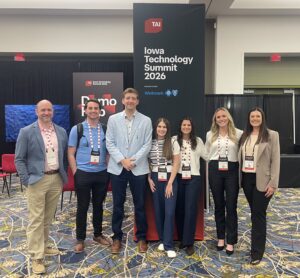
Last week Zirous attended Technology Association of Iowa’s 2026 Iowa Technology Summit, focusing on how technology has shifted to being a strategic, business-led enabler designed to elevate workers. We had the opportunity to hear from some of the most influential tech leaders in Iowa including CIOs, CEOs, AI Directors, and VPs from Casey’s, Holmes Murphy, EMC Insurance, Workiva, and Telligen. The event gave us a snapshot of the state of AI in Iowa from both a practical and strategic perspective. Here are the four key takeaways that stood out to me.
1. AI only matters when it’s tied to business outcomes.
Event Summary: From the opening keynote, the event stressed technology as an operating model that needs prioritization and resilience. AI is no exception. Sanjeev Satturu stressed that organizations shouldn’t get swept away in AI hype, and should instead focus on what problem they’re trying to solve, saying “Data is everywhere, but decisions are nowhere. People fall in love with data and forget about decision-making.” Echoing the idea of technology as a catalyst for problem-solving, Holmes Murphy’s leadership team described a mindset shift from technology-as-spend towards how the technology creates value when its capabilities align to customer needs. An AI leadership panel explained how they leverage AI to solve specific problems to see truly valuable outcomes, describing how their solutions are actively changing planning cycles, portfolio conversations, marketing analysis, and speed-to-insights.
What It Means: The companies who succeed in their AI implementations target not only specific use cases, but the ones that can produce a measurable business impact. As AI capabilities continue to grow, it only becomes more important that AI efforts have a clear connection to business value, as well as ensuring their infrastructure and data are up for the task. When AI can be plugged in anywhere, made useful to any team, and connect into your business data, organizations need to clearly identify how the technology will solve problems so it doesn’t just become an interesting add-on for getting work done.
2. AI is only a force multiplier if you’re focused on people.
Event Summary: AI is the great equalizer, making it easier than ever for anyone to be a subject matter expert. Nate Sepich drove home how natural language lowers the skill floor and lets more people participate in different kinds of fields so long as they know a goal and can communicate intent to a large language model. But as Phillip Shaka pointed out, people will resist AI if they don’t trust the system and if organizations only focus on tools and not whether employees trust the technology or the rollout. As said by the AI leadership panel, companies can create trust by modeling behaviors and creating space for experimentation, as well as when governance teams can serve as an enabling function to minimize risk and keep the business moving as described by Jeanna Schoonmaker.
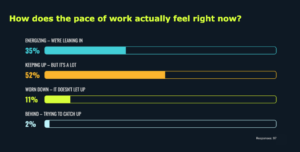
What it Means: While many Iowa leaders emphasize trust and encourage AI adoption, broader market trends tell a more complicated story. Recent mass layoffs have been tied, at least in part, to AI investment and usage, reflecting the tension many workers feel. That tension showed up at the Tech Summit as well: in a digital poll, just over half of attendees said the pace of work feels like “a lot,” 11% said they feel “worn down,” and only about a third said they feel energized by it. As AI accelerates the rhythm of work and makes everything feel faster and more frenetic, it becomes even more important to pause and think carefully about how AI can support people, not just speed them up.
At Zirous, we believe that speeding up or replacing work is only one measure of ROI to consider. Organizations need to consider how it can create value in other ways, such as enabling more innovation, improving frontline and back-end experiences, increasing equipment uptime, and freeing people to focus on higher-value work. The real opportunity is not simply to do the same work faster, or to ever fully replace humans with AI, but to use AI to help organizations operate better, serve people better, and create new value in the process.
3. IT is shifting to strategic business partnerships, not simply tech spend.
Event Summary: IT has traditionally been a technical influencer, but modern IT teams are shifting to business influencers. They are strategic thinkers for their organizations, not only in areas of technology but also business growth and innovation. The Technology Summit supported these ideas, with a four-person panel indicating that IT needs to become a strategic business partner and technology is now seen as a strategic business imperative, with one stating, “If we’re just implementers, we are not going to be as useful as an enabler to business strategies.” Holmes Murphy’s leadership concurred, saying that IT has to evolve to be a proactive driver of business value.
What it Means: Though this trend is broader than just an AI perspective, it maps to IT teams aligning AI technology across business operations to accomplish strategic initiatives. Not only has IT traditionally been seen as the tech hub of an organization, but it stereotypically is seen as a gatekeeper and bottleneck to innovation. As IT teams help businesses identify, prioritize, and scale the right initiatives to improve competitive advantage, they have an opportunity to be seen as business enablers rather than roadblocks. That strategy includes a deep understanding of not only the technical implications of AI systems and solutions, but also how they can deliver strategic business outcomes.
4. The practical landscape of AI within Iowa organizations
Event Summary: Beyond strategic steps forward, the Tech Summit also provided insight into how organizations are practically implementing AI systems in their organizations. Overall, businesses have moved beyond simple chatbot experiences and speakers assumed all attendees had access to at least one foundational, frontier technology such as Microsoft Copilot, ChatGPT, Gemini, or Claude. Meanwhile, mentions of agentic pilots and solutions focus primarily on individual productivity. However, agentic capabilities aren’t fully orchestrated across the enterprise, with only a handful of team-based workflows mentioned, such as translating meeting notes automatically into assigned Jira boards and stories. In fact, a majority of practical use cases are narrow in focus and aligned closely with pre-existing processes. Additionally, organizations embrace AI governance by actively initiating AI councils, steering committees, written processes, and training sessions, with some extending into observability capabilities.
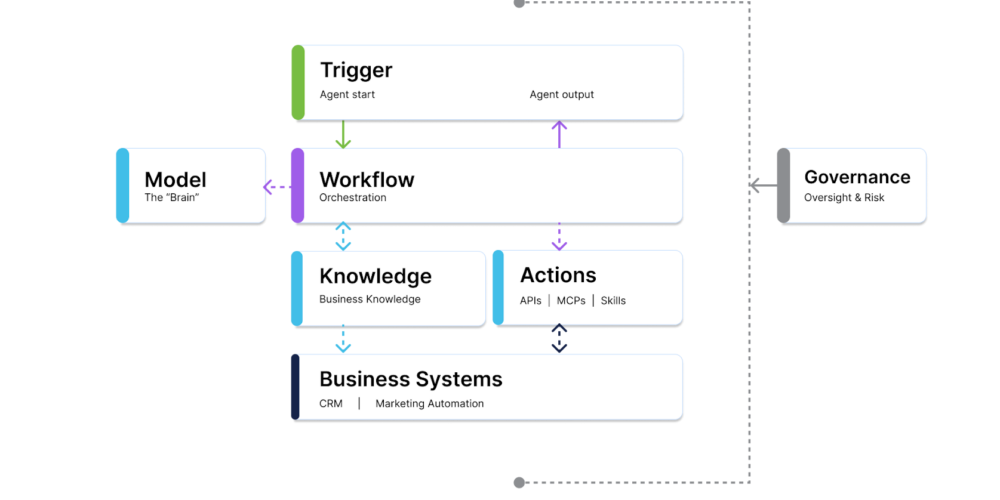
What it Means: Even though organizations are embracing agentic use cases at the individual layer—in some cases, en masse with over 700 agents within a single organization—it reveals that agentic AI isn’t creating scalable enterprise value beyond individual workflows. Agentic’s promise of true business transformation comes when organizations can operationalize those capabilities across teams through shared, governed workflows that connect data, decisions, and actions across the business. The organizations that make that leap will be the ones that move beyond isolated pilots and start using agentic AI to reshape how work gets done across the enterprise.
Join the Conversation
The Iowa Technology Summit keyed in on a critical point for organizations: AI implementation has to get more strategic and focused on business pains in order to deliver truly valuable outcomes. Organizations need to carefully consider their own use cases and challenges before understanding what kind of technology might be useful—whether it’s agentic AI, chatbot interfaces, or something new coming down the pipe.
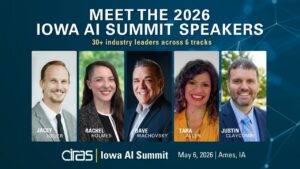
In May, I, Rachel Holmes, will be speaking at the 2026 Iowa AI Summit for Industry in Ames, Iowa, exploring what’s coming next for AI and how leaders can start preparing for what will matter most to them. For more information and to register, visit the event site.
Related Posts


Comments (0)